Rents are above-normal returns. This raises the question: what is a normal return?
Adam Smith described in The Wealth of Nations that the market price may deviate from a normal price, but that competition will force the market price to gravitate to the normal price. In other words: competitors will drive down prices until they allow for a normal Return On Investments (ROI), equal to the required rate of return to be able to finance investments and to survive in the long run.
A rule-of-thumb to approximate the normal ROI is the median ROI in the economy (the median ROI is better than the average because the median is not sensitive to outliers). However, this approximation is only suitable for a quick and initial estimation.
A better approach that is widely used in corporate finance and by investors is CAPM (Capital Asset Pricing Model). It is a valid approach because it includes market risks in the risk premium and excludes specific individual risks, so that the normal ROI is linked to the business cycle and not to specific factors such as the risks of individual firms. These specific risks should not be included because they can be covered by a diversified investment portfolio. The basic principle of CAPM is this distinction between risks that can be diversified and those that cannot, because they are related to the overall business cycle.
However, some types of business are more sensitive to the overall business cycle than others. In CAPM it is Beta that measures how sensitive a firm or industry is to the business cycle, see box1 below.
The CAPM approach is an approximation and not perfect, but the basic principle of distinguishing between specific individual risks and the overall risk of the business cycle is valid and important. Several attempts have been made to design more advanced methods to estimate the risk premium, but these attempts did not challenge the basic principle of CAPM and did not lead to considerably better results. For the time being it seems the best approach available.
| Beta Beta does not measure the variability of a firm or industry by itself, but it does measure how this variability is related to the business cycle. If beta is 1.5 this means that the variability of a firm is the same as the overall business cycle multiplied by 1.5 . Beta is calculated as the covariance of the rate-of-return of firm i and the market-rate-of-return divided by the variance of the market-rate-of-return. The average beta of all firms is 1. |
| Normal ROI The required or normal ROI is calculated as: ri = rf + beta (rm – rf) where ri = required rate of return for a firm or an industry, rm is the market rate of return, and rf is the risk-free rate (commonly proxied by a 10-year government bond). In other words: if beta = 1.5 then the required rate of return is the risk-free rate + 1.5 times the difference between market rate and risk-free rate. This is the premium for the risk of greater variability than the business cycle. The market rate rm is usually based on historical annual returns of all firms. For each year I use the median of all observations because the distribution of rates of return is skewed and has outliers. |
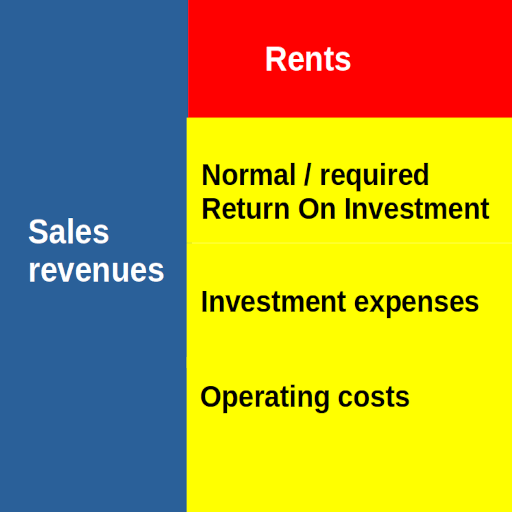
 Rents
Rents 